


So you’re ready to launch a podcast. Maybe you’ve got the perfect concept, a list of dream guests, and a content calendar ready to roll. But here’s the question that stops most creators in their tracks: how much does podcast production cost? The answer isn’t simple, but it’s critical to understand before you invest your time and money.
In 2026, podcast production costs range dramatically—from as little as $100 for a bare-bones DIY setup to over $20,000 per month for premium full-service production. The wide variance depends on whether you’re handling everything yourself or outsourcing to professionals, the quality level you’re targeting, and the marketing support you need to actually grow your audience.
In this guide, I’ll break down every cost component you need to know. You’ll discover exactly what you’re paying for at each price tier, hidden expenses most creators overlook, and how to make smart budgeting decisions that align with your goals. Let’s dive in.
Understanding Podcast Production Cost Basics
Before we get into specific numbers, it’s important to understand what drives podcast production costs in the first place.
At the most basic level, you need equipment to record audio. However, that’s just the starting point. You also need software to edit your recordings, a hosting platform to distribute your episodes, and ideally some design work for cover art and show notes.
Beyond the technical requirements, there’s the time investment. Editing a single episode can take anywhere from two to eight hours, depending on complexity. If you’re doing this yourself, that’s time away from your core business or creative work.
For example, if your time is worth $100 per hour and you spend six hours per episode on production tasks, that’s $600 in opportunity cost—even if you’re not paying anyone else. This is why many successful podcasters eventually outsource production, even if they start with DIY.
The key is understanding what you’re optimizing for: lowest upfront cost, highest quality, fastest growth, or time efficiency. Each goal leads to different budget decisions.
Equipment and Startup Costs for DIY Podcasters
If you’re considering the DIY route, your initial investment will depend on the quality level you want to achieve. Therefore, let’s break down three common tiers.
Hobbyist Setup ($130-$250)
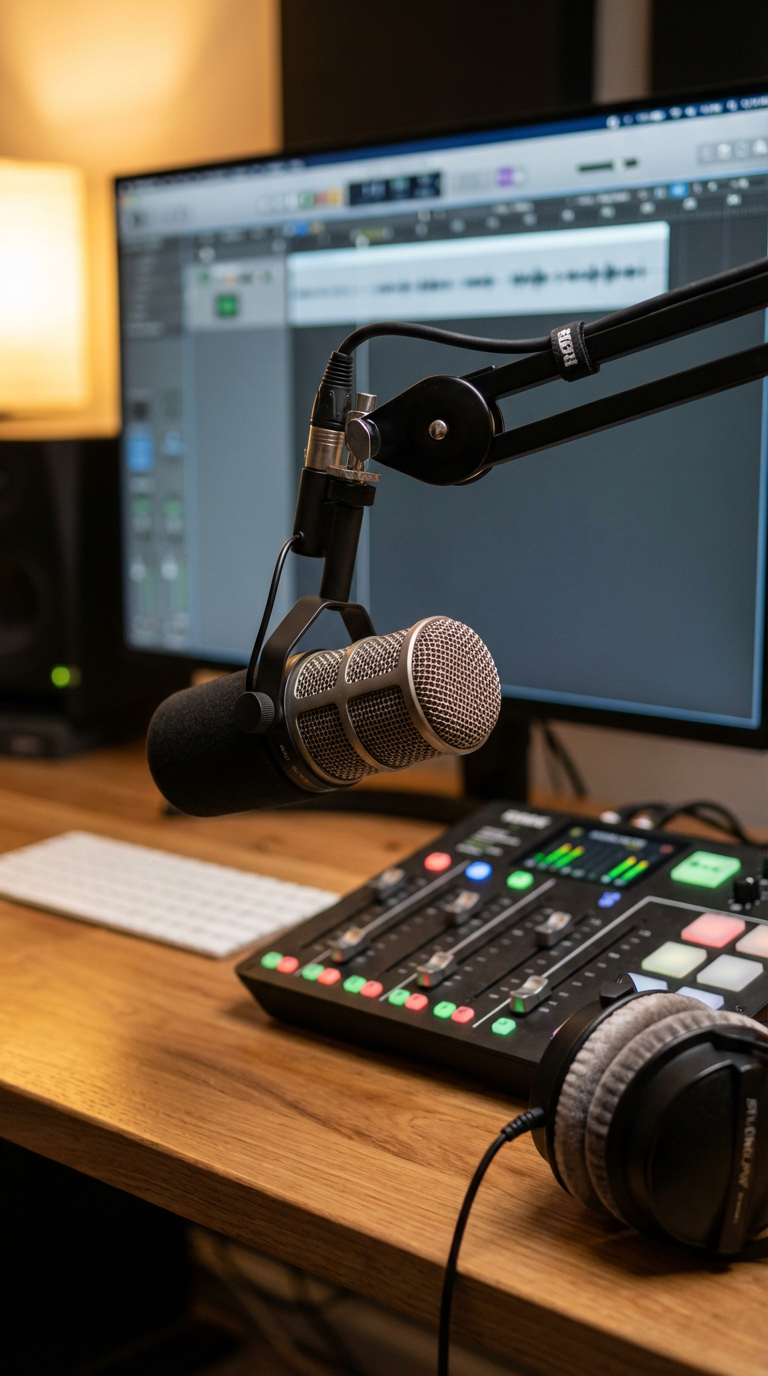
This is the entry point for most podcasters testing the waters. Your investment includes a basic USB microphone ($40-$60), decent headphones ($20-$30), and if you’re adding video, a webcam ($50-$80).
This setup works fine for interview-style shows or solo content where audio quality is acceptable but not broadcast-grade. You’ll use free editing software and likely record from your existing computer.
However, listeners will notice the difference in audio quality compared to professional productions. If your podcast is part of a business strategy, this tier may undercut your credibility.
Semi-Professional Setup ($509-$1,720)
As you get serious about podcasting, upgrading your equipment makes sense. This tier includes a better microphone ($60-$100), improved audio interface, quality headphones, and if you’re doing video, a real camera ($300-$500) instead of a webcam.
You’ll also invest in basic lighting ($100-$200) and potentially a simple backdrop. This is the sweet spot for most independent podcasters who want professional quality without breaking the bank.
Your audio will sound noticeably cleaner, which increases listener retention and makes your content more shareable.
Professional Setup ($1,070-$3,690)
For creators building podcasts as central business assets, the professional tier delivers broadcast-quality production. This includes high-end cameras ($500-$1,500), professional lighting systems ($200-$500), premium microphones, acoustic treatment, and professional-grade interfaces.
At this level, your production quality matches or exceeds what listeners hear from major podcast networks. If you’re interviewing high-profile guests or using your podcast for enterprise business development, this investment signals credibility.
Most podcasters start at the hobbyist or semi-pro level and upgrade as their audience grows. In addition, you can rent studio time ($300-$1,000 per session) if you need professional quality for specific episodes without the full investment.
Monthly Software and Hosting Expenses
Equipment is a one-time cost, but software and hosting create ongoing monthly expenses. These costs are unavoidable whether you’re DIY or working with a production company.
Hosting Platforms
Your podcast needs a hosting service to distribute episodes to Apple Podcasts, Spotify, and other directories. Basic hosting runs $5-$50 per month through platforms like Libsyn or Buzzsprout.
As your show grows and you want advanced analytics, dynamic ad insertion, or higher storage limits, hosting can increase to $20-$200 per month. The investment is worth it when you need data to prove ROI to sponsors or internal stakeholders.
Recording and Editing Software
Remote recording platforms that capture multi-track audio typically cost $20-$40 per month per host. This is essential if you’re interviewing remote guests and want each person on a separate audio track for easier editing.
Editing software ranges from free (Audacity, GarageBand) to $40 per month for professional tools like Adobe Audition. Most semi-serious podcasters land somewhere in the middle with tools like Descript or Reaper.
Your total monthly software and hosting baseline typically runs $50-$200, depending on your specific needs and scale.
How Much Does Podcast Production Cost for Editing Services?
Editing is where DIY podcasters spend the most time—and where outsourcing delivers the biggest time savings. If you’re considering hiring an editor, here’s what to expect.
Hourly Editing Rates
Podcast editors typically charge based on their experience level. Junior editors handling basic cuts and cleanup charge $25-$40 per hour. For a one-hour episode, this might translate to three to four hours of editing work.
Experienced editors who can handle complex mixing, sound design, and multi-track editing charge $50-$100 per hour. A typical episode requires about four hours of work at this level, totaling roughly $300 per episode.
Specialized editors with niche expertise (audio branding, narrative podcasts, investigative journalism) command $100-$200 per hour. You’re paying for creative direction, not just technical execution.
Per-Episode Pricing
Many editors offer flat per-episode rates instead of hourly billing. This creates more predictable budgeting for regular shows.
Basic editing services start around $50-$150 per episode for simple cleanup and cuts. Mid-tier editing with intro/outro music, noise reduction, and level balancing runs $150-$400 per episode.
Full-service post-production including sound design, advanced mixing, and multiple revision rounds can reach $500-$1,000+ per episode. However, this level of service transforms your audio into a polished, professional product that stands out in a crowded market.
Interestingly, the per-episode cost can vary from as low as $15 to as high as $15,000 depending on scope—highlighting why it’s crucial to define your quality standards and production complexity upfront.
Add-On Services
Beyond basic editing, several add-ons increase your total production cost but deliver significant value. Transcription services cost $1-$3 per minute of audio, creating searchable content and improving accessibility.
Audiograms (short video clips for social media) run $200-$800 depending on customization and quantity. Show notes and blog post creation typically cost $300-$1,000 per episode, depending on depth and SEO optimization.
These add-ons multiply your content’s reach and lifespan. Specifically, transcriptions boost SEO, while audiograms drive social engagement—both critical for growth.
If you’re looking for a team that handles all these elements strategically, 320 Creative’s services integrate editing, post-production, and content repurposing into cohesive packages designed for business podcasters who want results, not just deliverables.
Full-Service Podcast Production Pricing
Full-service agencies handle everything from recording to distribution to marketing. This is where podcast production costs scale significantly based on the level of strategic support you receive.
Budget Tier ($500-$1,500 per Episode)
At the budget tier, you’re essentially outsourcing editing and basic production tasks. The agency handles audio cleanup, episode assembly, and uploading to your hosting platform.
You still handle guest booking, content strategy, and promotional efforts yourself. This tier works well if you enjoy the creative and relationship sides of podcasting but want to eliminate the technical burden.
Mid-Tier Services ($1,500-$5,000 per Month)
Mid-tier packages typically include full editing, professionally designed graphics, transcription, show notes optimized for SEO, and two to four social media assets per episode.
Some providers include basic distribution strategy and performance reporting. At this level, you’re getting consistent, reliable production that frees you to focus on content and guest relationships.
For weekly shows, this usually translates to $375-$1,250 per episode when bundled monthly. The value increases significantly if the provider offers strategic guidance on content direction and audience growth.
Premium and Strategic Packages ($4,000-$20,000+ per Month)
Premium podcast production services include full-service production, strategic guest booking (often with conversion rates of 20-40% compared to 1-10% for DIY outreach), content marketing, SEO optimization, and detailed analytics reporting.
At this tier, you’re paying for “relationship engineering”—the strategic thinking that turns a podcast into a business development engine or thought leadership platform. The production company becomes a strategic partner, not just a vendor.
For enterprise-level productions or seasonal narrative podcasts, costs can reach $40,000-$100,000+ per season. This includes sound design, original music, professional voice talent, and comprehensive marketing campaigns.
The 40x price variation in podcast production services reflects this fundamental difference in scope. You’re not just comparing editing quality—you’re comparing business models and strategic value.
Hidden Costs and Marketing Investments
Beyond production, several hidden costs catch new podcasters by surprise. Marketing assets alone can cost $200-$500 per episode if you’re creating custom graphics, video clips, and promotional materials.
Guest booking services add $1,000-$3,000 per month but dramatically improve your guest quality and booking conversion rate. For B2B podcasts where guests become clients or partners, this investment often pays for itself with a single relationship.
SEO optimization for podcast show notes typically requires two to four hours per episode. If you’re outsourcing this work, budget $150-$400 per episode for quality content that actually ranks.
Website integration adds another $1,000-$5,000 for a custom podcast website or landing page. While this is a one-time cost, it’s essential for converting listeners into email subscribers or customers.
These “extras” often determine whether your podcast becomes a growth engine or just another content project. Therefore, smart podcasters budget for at least some marketing support from the beginning.
Launch Costs and One-Time Expenses
Starting a podcast involves several one-time costs beyond ongoing production expenses. A strategic launch typically costs $6,500-$28,000 total, though you can certainly launch for less if you’re extremely lean.
Strategy and concept development from a professional typically runs $3,000-$10,000. This includes competitive analysis, format development, content planning, and guest strategy. While it feels expensive upfront, a solid strategy prevents costly pivots later.
Branding and design (logo, cover art, visual identity) costs $500-$3,000. Your podcast artwork is the first thing potential listeners see in podcast directories, so it’s worth investing in professional design that stands out.
As mentioned earlier, website development adds $1,000-$5,000. A dedicated podcast website improves discoverability, provides better analytics, and creates opportunities for email capture that you don’t get from podcast directories alone.
Trailer and intro episode production might add $500-$2,000 if you’re working with professionals to create a strong first impression.
While these launch costs feel steep, they’re one-time investments that set up your podcast for long-term success. Many failed podcasts suffer from poor strategy and positioning—problems that are much harder to fix after launch.
The Real Cost of DIY vs. Outsourcing
The DIY vs. outsourcing decision ultimately comes down to time, quality, and business goals. Let’s examine the real costs of each approach.
DIY podcasting saves immediate cash but costs significant time. Industry data shows the typical episode requires four to eight hours of production work. At a conservative $100/hour opportunity cost, that’s $400-$800 in time per episode.
In addition, guest booking consumes 100-200 hours per month for active shows, representing $15,000-$40,000 in opportunity cost if you value your time appropriately. Over 52% of independent podcasters handle everything solo, but many burn out within the first year.
Outsourcing eliminates this time burden but requires upfront budget. The break-even calculation is straightforward: if your time is worth more than what you’d pay an editor or producer, outsourcing makes financial sense.
However, there’s a quality consideration too. Professional editors and producers bring expertise you can’t easily replicate, even with unlimited time. They understand audio dynamics, pacing, narrative structure, and technical nuances that make the difference between amateur and professional sound.
For business podcasts where credibility matters, professional production isn’t a luxury—it’s a strategic necessity. Your podcast represents your brand, and audio quality directly impacts how listeners perceive your expertise and professionalism.
As a result, many successful podcasters start DIY to test their concept, then transition to professional production once they validate audience demand and business impact.
Smart Budgeting Strategies for Podcast Production
With all these cost variables, how do you create a sensible podcast budget? Here are practical strategies that work across different business sizes and goals.
First, start lean but plan to scale. A $200-$400 initial equipment investment lets you test your concept without major financial risk. As your audience grows and you validate ROI, reinvest profits into better equipment or professional services.
Second, prioritize strategy over equipment. The difference between a $200 and $2,000 microphone matters far less than having a clear content strategy and target audience. Many successful podcasts started with basic equipment but exceptional strategy.
Third, track your opportunity cost honestly. If you’re spending six hours per episode on editing and your billable rate is $150/hour, you’re spending $900 in opportunity cost. At that point, paying an editor $300 per episode saves you $600 in time—plus you get better quality.
Fourth, bundle services when possible. Agencies offering monthly packages usually provide better per-episode value than paying a la carte. For example, a $3,000/month package for four episodes ($750 each) often includes services that would cost $1,200+ per episode individually.
Fifth, consider your customer acquisition cost (CAC). If your podcast generates one client worth $10,000 and your monthly production cost is $2,000, your podcast ROI is exceptional—even though $2,000 might feel expensive in isolation.
Finally, budget for a six to twelve-month runway. Podcasts rarely deliver immediate results. Success requires consistency over time, so ensure your budget can sustain production through the audience-building phase.
For podcasters who want professional guidance without the guesswork, working with an experienced team eliminates costly trial-and-error. Professional podcast production services provide clarity on exactly what you’re getting for your investment and how each element contributes to your business goals.
Making the Right Investment for Your Podcast
So, how much does podcast production cost? As you’ve seen, the answer ranges from under $200 for a basic DIY approach to $20,000+ monthly for strategic, full-service production.
The right investment depends entirely on your goals. If you’re podcasting as a hobby or creative outlet, DIY with modest equipment makes perfect sense. You’ll learn valuable skills and keep costs minimal.
However, if your podcast is a business development tool, thought leadership platform, or revenue-generating asset, professional production becomes a strategic investment rather than an expense. The difference in audio quality, consistency, and strategic execution directly impacts your results.
Remember that the most expensive option isn’t starting a podcast—it’s starting poorly and damaging your brand credibility, or worse, abandoning a potentially powerful business asset because you underestimated the time and expertise required.
Smart podcasters focus on the value equation: what will this podcast generate in business opportunities, brand authority, or audience growth? Once you understand that value, the production investment becomes much clearer.
As you evaluate your options, consider what success looks like six months or a year from now. Are you consistently producing high-quality episodes? Are you attracting the right guests and audience? Is your podcast generating measurable business results?
If you’re ready to launch a podcast that delivers real business results without the production headaches, 320 Creative specializes in strategic podcast production for brands and thought leaders who are serious about growth. We handle everything from recording to editing to distribution and content marketing, so you can focus on the conversations and relationships that matter most. Explore our podcast production services and discover how the right production partner transforms your podcast from a content project into a business asset.
The question isn’t whether you can afford professional podcast production—it’s whether you can afford not to invest in doing it right. Your audience, your brand, and your business deserve nothing less.