

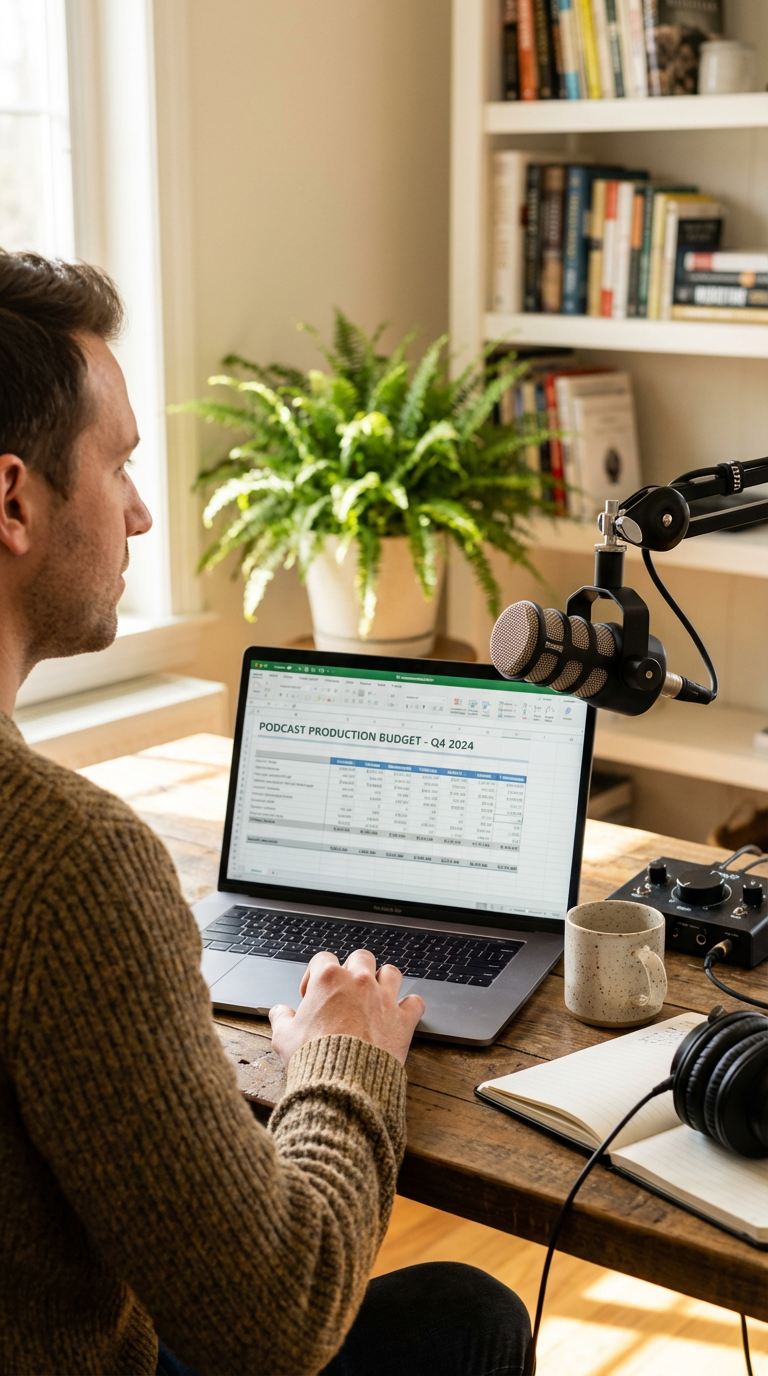

How Do I Create a Podcast Production Budget?
How do I create a podcast production budget that actually holds up episode after episode — without surprise overruns killing your momentum? That’s the question every entrepreneur, brand builder, and content strategist should be asking before they hit record. A podcast production budget isn’t just a spreadsheet. It’s a strategic blueprint that determines whether your show grows or quietly disappears after six episodes. Whether you’re launching a solo thought leadership podcast or building a fully branded content series, knowing your real costs upfront changes everything.
In 2026, podcasting is one of the most powerful business growth channels available. However, it’s also one of the most misunderstood from a financial perspective. Most creators dramatically underestimate production costs — and overestimate how quickly revenue kicks in. This guide gives you a clear, practical framework to create a podcast production budget that reflects reality, not wishful thinking.
Why Every Serious Podcaster Needs a Podcast Production Budget
Here’s what typically happens without a budget. A founder buys a microphone, downloads a free editing app, and launches a show. Three months in, they realize editing alone takes four to five hours per episode. Add music licensing, hosting fees, transcription, and show notes — and costs are two to three times higher than expected. The show stalls. The investment goes to waste.
A well-structured podcast production budget solves that problem before it starts. Specifically, it does four critical things for your business:
- Organizes every cost category — equipment, editing, hosting, music, distribution, and marketing — into one clear view.
- Calculates your true per-episode cost so you can make informed decisions about scale and format.
- Creates a sustainable production roadmap aligned with your episode frequency and growth goals.
- Connects your podcast to a revenue strategy — whether that’s sponsorships, lead generation, or brand authority building.
Without a budget, you’re guessing. With one, you’re executing a plan. That distinction is the difference between a podcast that becomes a business asset and one that becomes an expensive hobby.
How Do I Create a Podcast Production Budget? A Step-by-Step Framework
Let’s get practical. Here’s the exact step-by-step process to build a podcast production budget from scratch. It works for solo shows, interview formats, and fully branded corporate content.
Step 1: Define Your Format and Episode Frequency
Before you budget a single dollar, answer these foundational questions:
- Will you record solo, with co-hosts, or primarily with guests?
- How frequently will you publish — weekly, biweekly, or monthly?
- Will you record remotely or in a physical studio?
- What production quality level fits your brand positioning?
These decisions drive every cost downstream. A solo weekly podcast with minimal editing has fundamentally different budget requirements than a polished, multi-guest branded series. Nail your format first. Then build your numbers around it.
Step 2: Break Down Every Cost Category
A complete podcast production budget includes six primary cost categories. Here’s what each one covers and what you should realistically expect to spend.
Equipment: This is your one-time startup investment. A solid USB microphone setup runs $150–$500. A professional studio configuration — including interface, condenser mic, headphones, and acoustic treatment — can reach $1,000–$3,000 or more. The good news? Equipment is a capital expense. You pay it once and amortize it over hundreds of episodes.
Software and Editing: Free tools like Audacity or GarageBand are perfectly functional for beginners. However, if you outsource editing — which most serious podcasters should — expect to pay $75 per hour on average. Post-production typically takes three to five hours per episode, therefore your outsourced editing cost runs $225–$375 per episode. This is the most underestimated line item in almost every podcast budget.
Hosting and Distribution: Platforms like Buzzsprout or Libsyn run $15–$50 per month. This is an ongoing operational cost that rarely changes much in Year 1. Budget it annually — $180–$600 per year — so it doesn’t sneak up on you.
Music and Sound Design: Royalty-free tracks cost $10–$100 per license. A custom-composed theme runs $500–$3,000, depending on the composer. For most business podcasts, a quality royalty-free track is more than sufficient at launch. You can always commission original music as the show grows.
Transcription and Show Notes: Transcription runs $1–$1.50 per minute for human services, or comes free with automated tools built into many hosting platforms. Importantly, show notes and transcripts improve your podcast’s SEO footprint significantly. Don’t skip them.
Marketing: This is the most variable line item in your podcast production budget. Starter budgets allocate $50–$100 for basic branding and social promotion. As you scale, professional podcast marketing — including paid distribution, social ads, and event sponsorships — can reach $50,000–$100,000 annually. Start lean. Scale based on what’s converting.
Step 3: Calculate Your Per-Episode Cost
Once you’ve mapped every category, divide your totals by your projected episode count. Here’s a simple example for a biweekly show (26 episodes per year):
- Outsourced editing: $300/episode
- Hosting (prorated): $20/episode
- Music licensing (amortized): $5/episode
- Transcription: $25/episode
- Marketing (prorated): $50/episode
Total per-episode cost: approximately $400
This number matters. It tells you exactly what each episode costs to produce. As a result, you can calculate what you need to earn — through sponsorships, lead generation, or brand value — to make each episode profitable.
Step 4: Project Revenue and ROI Over 12 to 36 Months
A podcast isn’t a cost center — at least, it shouldn’t be. For most brands, it’s a revenue and authority engine. Sponsorship revenue typically begins after you establish a consistent audience. Independent business podcasters typically charge $18–$25 CPM for mid-roll ads. At 10,000 downloads per episode, a single mid-roll ad slot generates $180–$250. Two slots per episode brings in $360–$500.
In addition to ad revenue, a well-positioned podcast drives qualified business leads. That ROI is harder to measure directly, but for B2B brands and service businesses, it frequently outpaces direct sponsorship income.
If you’re building toward a significant content operation, projections can be compelling. One case study model shows a $250,000 startup investment in equipment and marketing yielding $475,000 in Year 1 revenue through sponsorships, branded content deals, and ad placements. By Year 3, cumulative cash can reach $857,000 — with a 26-month breakeven point.
That level of return requires serious investment and planning. But even a modest branded podcast can generate five to six figures annually in attributed leads and sponsorship. The key is projecting it honestly from day one.
If you’re unsure how to model your revenue timeline, the team at 320 Creative helps entrepreneurs map realistic podcast ROI projections as part of their launch strategy. Getting this right early saves both money and frustration down the road.
Podcast Production Budget by Quality Level
Your podcast production budget will look very different depending on your quality goals. Here’s a clear breakdown of three production tiers, so you can choose the right starting point.
Tier 1 — DIY Starter Budget (Under $500 Total)
This tier works well for founders testing a format, solo thought leaders entering podcasting for the first time, or brands validating audience demand before committing to higher production costs.
- USB microphone (Blue Yeti or Audio-Technica ATR2100x): $100–$150
- Free editing software (Audacity or GarageBand): $0
- Podcast hosting (Buzzsprout starter plan): $0–$144/year
- Royalty-free music license: $10–$30
- Total startup cost: $150–$500
The tradeoff here is time. You’re handling recording, editing, show notes, and distribution yourself. That’s fine for a pilot phase. However, track your hours carefully — your time has real value, and it shows up in your true per-episode cost even when it doesn’t appear on a balance sheet.
Tier 2 — Mid-Level Remote Interview Budget ($300–$800 Per Episode)
This is the sweet spot for most business podcasters. You’re investing in recording quality and outsourcing the time-intensive work so you can focus on content and guests.
- Professional XLR microphone and audio interface: $300–$600 (one-time)
- Riverside.fm for high-quality remote recording: $15–$24/month
- Outsourced editing (3–5 hours at $75/hour): $225–$375/episode
- Hosting and distribution: $20–$50/month
- Show notes and transcription: $30–$50/episode
- Per-episode cost: $300–$800 depending on frequency and scope
This setup delivers professional audio quality with a manageable workload. For entrepreneurs building thought leadership through guest interviews, this tier hits the right balance of investment and output.
Tier 3 — Professional Branded Podcast ($2,000–$10,000 Per Episode)
This tier is for brands that view podcasting as a primary content marketing channel — and have sponsorship or content licensing revenue to match.
- Professional studio setup or rental: $500–$1,500 per session
- Full post-production team (editing, mixing, mastering): $500–$2,000/episode
- Original music and custom sound design: $500–$3,000
- Dedicated podcast marketing and paid distribution: $5,000–$10,000/month
- Staff salaries or senior contractor fees: $100,000+/year
At this level, you’re running a media operation inside your business. The production quality is exceptional, the audience is targeted, and the revenue potential is significant. Specifically, brands operating at this tier frequently unlock six-figure sponsorship deals and premium content licensing arrangements.
At 320 Creative, we’ve worked with brands across all three tiers. Whether you’re launching your first episode or scaling a full content operation, 320 Creative’s services are built to match your budget with the right production strategy — so every dollar works harder.
The Hidden Costs That Blow Most Podcast Budgets
Even experienced podcasters get blindsided by these overlooked expenses. Factor them into your podcast production budget before you launch.
Post-Production Time: This is the number one underestimated cost. Editing a 45-minute interview episode typically takes three to five hours — not one. If you’re outsourcing at $75/hour, that’s $225–$375 per episode before you’ve spent a single dollar on anything else.
Guest Coordination: Scheduling, pre-interview prep calls, and post-interview follow-up all take time. If you’re using a producer or executive assistant, add two to three hours of labor per guest episode to your cost model.
Legal and Licensing Fees: Music licensing, guest release agreements, and business entity setup run $200–$500 in startup costs. These are easy to overlook but essential to protect your content.
Equipment Refresh Cycles: Technology improves. Audience expectations rise. Budget for annual equipment upgrades — even $200–$500 per year keeps your production quality competitive.
Ongoing Software and Platform Fees: Remote recording software, digital audio workstation subscriptions, transcription services, analytics dashboards, and scheduling tools all add up. Budget $50–$200 per month for ongoing tech infrastructure.
Tools and Templates to Map Your Podcast Production Budget
You don’t need to build your podcast production budget from scratch. These tools make the process faster and more accurate.
Custom Spreadsheet Template: The most flexible starting point. Build columns for category, one-time startup cost, monthly ongoing cost, per-episode cost, and annual projection. This structure gives you a complete picture of both capital expenses and operational burn.
Saturation.io Free Budget Template: A well-designed free tool that covers all major podcast cost categories and auto-calculates your per-episode cost for both independent and branded shows.
Business Planning Tools: For founders building investor-ready podcast businesses, tools like Bizplanr support three-year financial projections with revenue, COGS, and operating expense breakdowns. One sample projection models $475,000 in Year 1 revenue against $160,000 in COGS — useful benchmarks for serious content operations.
Hosting Platform Analytics: Platforms like Buzzsprout include built-in download analytics that help you track growth, calculate CPM-based revenue potential, and make data-driven decisions about scaling your marketing spend.
Before you build your budget, it helps to understand the full scope of what launching a podcast actually involves. Check out our complete podcast launch checklist to make sure you’re not missing critical steps that affect your cost model.
How to Scale Your Podcast Production Budget Strategically
The most successful podcasters don’t spend the most — they allocate strategically. Here’s how to scale your podcast production budget without overspending at any stage.
Start lean, then reinvest returns. Launch with a $500–$700 starter setup. Use your first 15–20 episodes to test your format, refine your content, and measure audience response. Then reinvest early revenue into production upgrades based on proven demand.
Outsource editing before anything else. As a founder or executive, your time is almost certainly worth more than $75 per hour. Outsourcing editing immediately frees you to focus on content quality, guest relationships, and business development — the things that actually grow the show.
Let download data drive your sponsorship strategy. Once you hit 5,000–10,000 downloads per episode consistently, you can pitch sponsors with confidence. Sponsorship revenue at that level can offset your entire per-episode production cost.
Diversify your revenue streams early. Don’t depend solely on sponsorships. Branded content deals, affiliate relationships, premium episodes, and lead generation for your core business often deliver stronger ROI — especially in the early stages before audience scale.
Measure marketing by conversion, not impressions. Track which channels actually drive listeners and leads. Targeted digital campaigns and QR-coded touchpoints frequently outperform broad awareness spend for niche business podcasts.
For a deeper look at turning listeners into leads, explore our podcast marketing strategy guide — it pairs directly with your production budget to create a complete growth plan.
Build a Podcast Production Budget That Grows With You
Creating a podcast production budget isn’t a one-time exercise. It’s a living document that evolves as your show grows, your audience deepens, and your revenue diversifies. Start with an honest assessment of your format, frequency, and quality goals. Break down every cost category — including the hidden ones. Calculate your true per-episode cost. Then project your revenue so you know exactly when and how your show becomes financially self-sustaining.
The podcasters building real business impact in 2026 aren’t the ones with the biggest budgets. They’re the ones with the most strategic ones — shows built on clear financial frameworks, consistent production quality, and smart reinvestment as they grow.
If you’re ready to launch or scale your podcast with a production strategy that’s financially sound and built for business results, 320 Creative is here to help. We work with entrepreneurs, founders, and growing brands to build podcast systems that deliver authority, generate qualified leads, and produce measurable ROI. From budget planning to full production management, our team brings the strategy and execution together. Explore 320 Creative’s podcast production services and let’s build a show that works as hard as you do.