


What Equipment Do I Need for Video Podcast Production?
You’ve decided to launch a video podcast. That’s one of the smartest moves you can make for your personal brand right now. But here’s the question every entrepreneur asks before hitting record: what equipment do I need for video podcast production? The answer doesn’t have to be overwhelming. In fact, the right gear setup can be simple, scalable, and surprisingly affordable — if you know what to prioritize from the start.
In this guide, we’ll break down every core category of video podcast equipment. Whether you’re starting from scratch or ready to upgrade your current setup, this is your practical, no-fluff roadmap to producing professional-quality video content that builds real authority.
Why Video Podcast Production Changes Everything for Entrepreneurs
Podcasting alone is powerful. Add video, and the impact multiplies significantly. Video podcasts generate shareable clips for LinkedIn, YouTube Shorts, Instagram Reels, and TikTok — all from a single recording session.
For CEOs and founders, this means one hour of recording can fuel an entire week of content across multiple platforms. However, only well-produced video content earns your audience’s trust. Blurry footage or muffled audio signals low credibility instantly. Therefore, investing in proper video podcast production gear isn’t optional — it’s foundational to your content strategy.
The good news? You don’t need a Hollywood budget to look and sound great. You just need the right tools in the right order. Social algorithms in 2026 actively favor high-quality video, which means better production value directly translates to greater reach and faster audience growth.
What Equipment Do I Need for Video Podcast Production?
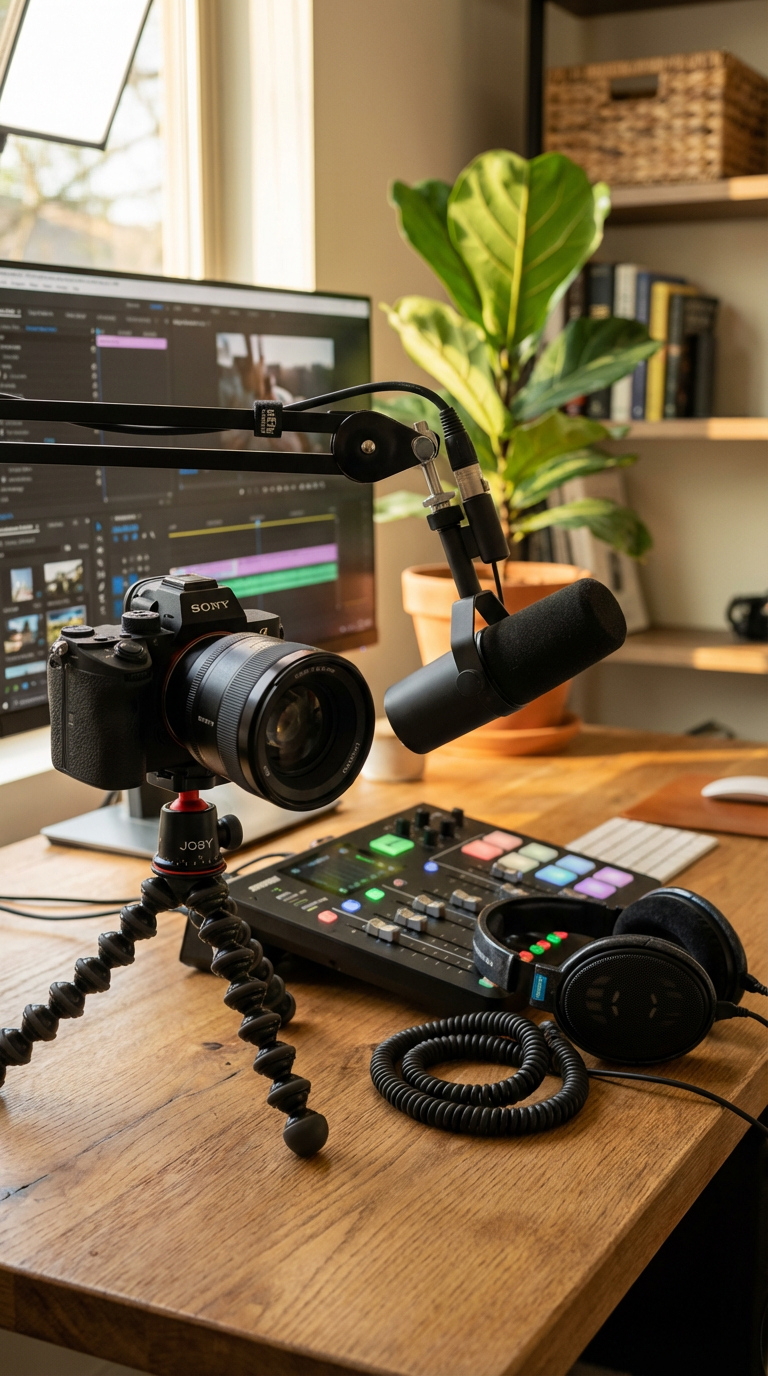
Let’s get specific. Below, we’ll cover every core category of video podcast production equipment — cameras, microphones, lighting, mixers, headphones, and editing software. We’ll also share budget-friendly picks alongside pro-level upgrades so you can build a setup that fits exactly where you are right now.
Cameras: Sharp Video That Commands Instant Attention
Your camera is your first impression on every viewer. Fortunately, you have excellent options at every price point — and you don’t need to spend thousands to look professional.
Budget-Friendly Picks: If you’re just starting out, the Logitech StreamCam or a GoPro HERO12 are outstanding entry points. Both offer USB plug-and-play simplicity with zero driver headaches. They produce solid 1080p to 4K footage and work straight out of the box with your laptop. For entrepreneurs who record on the go, the GoPro’s waterproof durability is a genuine bonus.
Mid-Range Upgrade: The Sony Alpha a6400 is arguably the best mirrorless camera for video podcasters in this price range. It delivers stunning 4K footage, exceptional autofocus tracking, and a lightweight body that travels well. The Canon EOS Rebel T7i is another strong DSLR option with beautiful color science and the flexibility of interchangeable lenses.
Both cameras let you achieve that cinematic depth-of-field effect — the soft, blurred background that visually separates you from your environment. As a result, your on-camera presence looks immediately more polished and authoritative.
Pro Tip: Pair any camera with a stable tripod from day one. Mirrorless cameras are trending in the video podcasting space because they’re lighter than DSLRs without sacrificing image quality. Traveling founders will especially appreciate this advantage. Importantly, always look for a camera with a clean HDMI output — this enables seamless connection to a capture card or audio mixer for a streamlined recording workflow.
Microphones: Because Audio Is 80% of Your Podcast’s Success
Here’s the truth most beginners get wrong: your audience will forgive average video quality. They will not forgive bad audio. Poor sound causes listeners — and viewers — to click away within the first thirty seconds. Therefore, your microphone deserves the most intentional investment of all your video podcast equipment.
Starter Option: The Samson Q2U is one of the best-kept secrets in podcasting. It’s a USB/XLR hybrid dynamic microphone available for under $100. You can plug it directly into your computer via USB today, and later connect it to a professional mixer via XLR as your show scales. That flexibility makes it a genuinely future-proof investment.
Studio-Grade Picks: Once you’re ready to step up, consider the Shure SM7B, the RØDE PodMic, or the Audio-Technica AT2020. The SM7B is famously used by top podcasters and broadcasters worldwide for its warm, commanding vocal tone. The PodMic from RØDE is specifically engineered for spoken-word recording and rejects background noise beautifully.
Pair your microphone with a boom arm and shock mount. This eliminates desk vibrations and keeps your mic at the ideal position — directly in front of your mouth, slightly below eye level for a natural, confident look on camera.
For Noisy Environments: If you’re recording in a home office or co-working space, dynamic microphones like the Shure SM58 or Audio-Technica ATR2100x-USB are excellent choices. Dynamic mics naturally reject ambient noise, picking up primarily what’s directly in front of them. This means you’ll sound clean even in imperfect rooms.
If you’re serious about producing a podcast that positions you as a genuine thought leader, the team at 320 Creative’s services can help you design a complete production workflow — from gear selection to multi-platform distribution strategy — so nothing falls through the cracks.
Lighting: The Difference Between Amateur and Authority
Lighting is the most underestimated element of video podcast production. Specifically, a great camera with poor lighting looks worse than a basic webcam with great lighting. The visual impact is that dramatic.
Key Light Options: The Elgato Key Light MK.2 is a top choice for busy entrepreneurs. It’s app-controlled, dimmable, and produces soft, flattering illumination that mimics a professional studio environment. The NEEWER PL60C is a more affordable alternative featuring RGB color options — useful for dialing in brand-specific color aesthetics that make your set visually distinctive.
Ring Lights: If you need a portable solution for recording outside your home office, an 18-inch NEEWER ring light is an excellent travel-friendly option. It creates a soft, even glow, wraps around your face flatteringly, and packs into a carry bag you can take to conferences or off-site locations.
The Simple 3-Point Lighting Rule: Position your key light at a 45-degree angle to your face. Place a softer fill light on the opposite side to reduce harsh shadows. Add a backlight behind you to create visual separation from the background. This straightforward three-light setup is exactly what professional studios use — and it works beautifully in a home office or spare bedroom.
Good lighting makes you look confident, competent, and credible on screen. For executives building authority through video content, that first visual impression carries enormous weight. Don’t cut corners here.
Headphones and Audio Mixers: Monitor and Mix Like a Pro
Many new video podcasters skip monitoring headphones entirely — and they regret it as soon as they review their first recording. Wired headphones let you hear exactly what your microphone is capturing in real time. This prevents the costly post-recording discovery of background noise, echo, or audio bleed from other sources.
Top Headphone Picks for Video Podcast Production:
- Audio-Technica ATH-M30x — Affordable, accurate, and comfortable for extended recording sessions
- Beyerdynamic DT 770 PRO — Studio-grade closed-back design with superior isolation from external noise
- Sony MDR-7506 — An industry standard trusted by broadcast engineers and podcast producers worldwide
As a starting point with zero cost, Apple EarPods work surprisingly well for latency-free self-monitoring. However, upgrading to over-ear studio headphones dramatically improves your ability to catch audio issues before they become expensive editing problems.
Audio Mixers — The Single Biggest Upgrade You Can Make: The RØDECaster Duo and RØDECaster Pro II are the most impactful upgrades for serious video podcast production. These all-in-one audio interfaces handle multiple microphone inputs simultaneously, apply real-time processing including noise gates and compression, and output broadcast-ready audio directly via USB. For multi-guest interview formats, they’re essentially essential.
The RØDECaster ecosystem pairs perfectly with the PodMic as a complete bundle. Together, they replace a rack of separate audio devices and significantly reduce both setup time and post-production work. In addition, RØDE’s Creator Bundle gives you everything you need in one box — maximizing ROI and minimizing gear complexity.
Not sure how to structure your full production setup? Explore our guide to building a streamlined podcast production workflow that saves you hours every single week.
Editing Software: Streamline Your Post-Production Process
Your editing software is where raw footage becomes a polished episode. The good news is that you don’t need expensive or complicated tools to produce professional video podcast content.
Top Editing Tools for Video Podcasters:
- Descript — AI-powered editing that lets you cut audio and video simply by editing a text transcript. For time-starved founders, this is genuinely revolutionary.
- DaVinci Resolve — A professional-grade video editor with powerful color grading tools, available completely free. This is the same software used by major film and TV productions.
- CapCut — Ideal for rapidly creating short-form social clips from your longer episodes. It’s mobile-friendly, fast, and designed for content creators who need to move quickly.
In addition, using your camera’s clean HDMI output into a capture card or audio mixer creates a seamless workflow between hardware and software. This significantly reduces the need for heavy post-production color correction and audio cleanup.
The dominant trend among high-output creators in 2026 leans toward hardware-software bundles — specifically the RØDE ecosystem — because they dramatically compress post-production time. As a result, you can focus on creating content that converts viewers into clients rather than spending hours in an editing timeline.
Video Podcast Gear Kits by Budget
Now let’s bring it all together. Here’s exactly how to build your video podcast setup based on where you are financially right now.
Starter Kit — Around $500
- Camera: Logitech StreamCam (~$100)
- Microphone: Samson Q2U (~$70)
- Lighting: NEEWER 18-inch ring light (~$50)
- Headphones: Audio-Technica ATH-M30x (~$70)
- Boom Arm: Basic desk mount (~$25)
- Editing Software: Descript (free tier available)
This starter setup lets you record and publish today with more than enough quality to start building your audience. Specifically, the fully USB-based gear means zero complex configuration — just plug in and record. That simplicity is a major advantage when you’re still developing your content rhythm.
Pro Kit — Around $2,000
- Camera: Sony Alpha a6400 (~$900)
- Microphone: RØDE PodMic (~$100)
- Audio Mixer: RØDECaster Duo (~$300)
- Lighting: Elgato Key Light MK.2 (~$200)
- Boom Arm: RØDE PSA1+ (~$100)
- Headphones: Beyerdynamic DT 770 PRO (~$180)
- Editing Software: DaVinci Resolve (free) or Descript Pro (~$24/month)
This pro setup scales effortlessly to multi-guest interview formats. It produces broadcast-quality output and positions you to repurpose content across every major platform without compromise. Research consistently shows that high-quality video podcast production grows audiences two to three times faster than low-production alternatives. The ROI on this investment compounds significantly over time.
For a deeper look at turning your podcast into a lead-generation engine, explore our resource on podcast strategy for entrepreneurs and founders.
Common Mistakes First-Time Video Podcasters Make
Knowing what to buy is half the battle. Knowing what to avoid is equally important. Here are the four most common mistakes we see from first-time video podcast producers.
Mistake #1: Prioritizing Video Over Audio
Most beginners spend the majority of their budget on an impressive camera and completely neglect the microphone. However, as we covered earlier, listeners will tolerate mediocre video far longer than they’ll tolerate bad audio. Always invest in your microphone first.
Mistake #2: Ignoring Your Recording Environment
Even the best microphone picks up echo and reverb in a bare, untreated room. Add soft furnishings — rugs, curtains, bookshelves, or acoustic panels — to naturally absorb sound reflections. For example, recording in a walk-in closet surrounded by hanging clothes produces surprisingly clean audio with zero cost.
Mistake #3: Overcomplicating the Initial Setup
It’s tempting to purchase every piece of gear at once. Resist that impulse. Start lean with the essentials, learn your tools thoroughly, and upgrade strategically based on what your audience responds to. Complexity is the enemy of consistency.
Mistake #4: Skipping Lighting Entirely
Many new video podcasters record using whatever ambient window light happens to be available that day. This produces unflattering shadows, inconsistent color temperature between episodes, and a generally unprofessional visual appearance. Even a single key light fundamentally transforms how you look and feel on camera.
Start Small, Build Authority, Scale Smart
The most important insight about video podcast production equipment is this: you don’t need to buy everything at once. Start with the essentials — a capable camera, a quality microphone, and one reliable light source. Master those tools completely. Then upgrade strategically as your show grows and your revenue supports it.
The entrepreneurs winning on video podcasts in 2026 aren’t necessarily those with the biggest gear budgets. They’re the ones who showed up consistently, delivered genuine value, and presented themselves with enough production quality to earn and keep their audience’s trust.
That’s exactly what the right video podcast production equipment helps you do. It removes friction, eliminates technical barriers, and lets your expertise take center stage — where it belongs.
If you’re ready to build a video podcast that genuinely grows your brand and generates real business results, the team at 320 Creative is built for exactly this. We specialize in helping founders, executives, and thought leaders launch and produce shows that position them as the go-to authority in their space — handling everything from gear consulting and studio setup to full-service production and multi-platform distribution. We make the entire process simple so you can focus on what you do best: leading, speaking, and growing.
Your audience is out there. Your ideas are ready. Now it’s time to hit record.